
If you’ve ever sat in a dental chair and heard a treatment recommendation that made you pause, you’re not alone. Maybe it was a crown when you thought you just needed a filling, or it was a deep cleaning when you expected a routine one.
Those moments create doubt. Once doubt creeps in, it’s hard to shake. You start wondering whether every recommendation is really about your health or about the practice’s bottom line.
That’s a fair question. Especially in a city like Skokie, where you have plenty of dentists to choose from. P&E Dental is down the street, and Vista Dental is nearby. You have plenty of options within a few miles of Old Orchard.
So here’s an honest answer from our side. Not a sales pitch, just how Dr. Paul Chaiken actually decides what to recommend and what to leave alone.
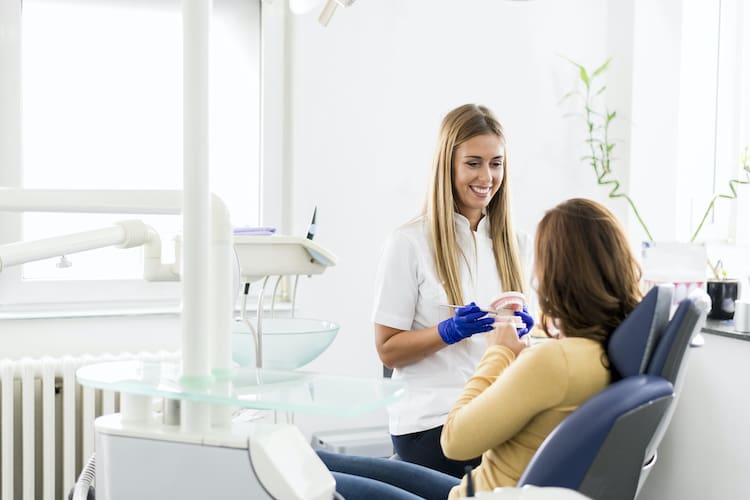
The Conservative Approach Isn’t a Marketing Slogan
We hear a lot of dental practices describe themselves as “conservative.” It’s a nice word, but what does it actually mean?
For Dr. Chaiken, it means a few specific things:
- It means watching instead of treating when watching is the right call. Not every small cavity needs to be drilled immediately. Some can be monitored. Some can be reversed with fluoride and better home care. If a tooth can wait, we’ll tell you it can wait.
- It means recommending the smallest effective treatment. If a filling will work, we won’t suggest a crown. If a crown will work, we won’t suggest an implant. The goal is to preserve as much of your natural tooth as possible, for as long as possible.
- It means saying no to treatment you’ve asked for. Sometimes patients come in wanting a full smile makeover, and Dr. Chaiken tells them they don’t need it. Maybe they need whitening and a small bonding fix. Maybe they need nothing at all. That conversation happens more often than you’d think.
- It means referring out when a specialist is the better choice. Dr. Chaiken has relationships with periodontists, oral surgeons, and other specialists. If a case is better handled elsewhere, he’ll say so. Even if it means less revenue for the practice.
That’s what conservative dentistry looks like in practice. It’s about doing what’s actually needed.
A Real Patient Said It Better Than We Could
One of our long-time patients, Kathleen McGrath, put it this way in a review:
“Dr. Chaiken is conservative in his work, not pushing for things that are extreme for the situation. My teeth have been healthy and happy.”
She’s been coming to our office for 30 years. Her children grew up as patients here. She’s seen Dr. Chaiken’s approach play out over decades, and she described it better than any marketing copy ever could.
That’s the thing about conservative care. It shows up over time. A patient who’s been with the same dentist for 30 years and still has healthy teeth proves the approach works.
How Dr. Chaiken Decides What to Recommend
There’s no single formula. Every mouth is different. Here’s the thinking behind every recommendation.
Step 1: Get a complete picture. Dr. Chaiken doesn’t just look at the tooth that’s bothering you. He looks at your whole mouth, bite, gums, and jaw. Problems in one area often have roots in another. A cracked tooth might be a bite issue, not a tooth issue. A worn filling might signal grinding, not failure.
This is where the practice’s technology helps. We use digital X-rays, intraoral cameras, and AI-assisted radiological tools to see what’s happening under the surface. The optical scanner lets us take digital impressions without the goop. These tools give us a clearer picture so we can make better decisions.
Step 2: Consider the whole patient. Your medical history matters, your medications matter, your anxiety level matters, and your budget matters. A recommendation that ignores any of those things isn’t a good recommendation, even if it’s technically correct.
Step 3: Present options, not ultimatums. You should never feel like you’re being told what to do. You should feel like you’re being given choices and the information to make a good decision. If there’s a more affordable option that would work, we’ll tell you about it. If there’s a more durable option that costs more, we’ll tell you about that too.
Step 4: Explain the reasoning. Every recommendation should come with a clear explanation of why. Not just “you need a crown,” but “here’s what we’re seeing, here’s why it matters, and here’s what happens if we don’t treat it.”
Step 5: Respect the answer. If you decide to wait, that’s your call. We’ll tell you what to watch for and when to come back. We won’t push.
Why Dr. Chaiken’s Background Matters Here
Dr. Chaiken has been practicing dentistry for more than 30 years. He earned his dental degree from Loyola University School of Dentistry in 1984. Since then, he’s completed advanced training in cosmetic dentistry, implant dentistry, TMJ therapy, root canal therapy, sleep apnea treatment, Invisalign, and sedation dentistry.
He’s also a fellow of the American College of Dentists and the Academy of General Dentistry. He’s an assistant clinical professor at Northwestern University School of Medicine. He was selected to serve on the clinical advisory boards of two dental research publications and the American Medical Association. He’s a published author and medical consultant to the AMA on three books: the AMA Complete Guide to Women’s Health, the AMA Complete Guide to Men’s Health, and the AMA Complete Guide to Your Children’s Health.
That last one matters for this conversation. Writing for the AMA means writing at a level where every recommendation has to be evidence-based and defensible. You can’t recommend a treatment for marketing reasons when you’re writing for a medical publisher. That standard carries over into how he practices.
Dr. Angel Frazier, who recently joined the practice, brings a similar philosophy. She’s completed extensive advanced training in dental implant placement and restoration and has a special interest in cosmetic dentistry and oral surgery. Together, Dr. Chaiken and Dr. Frazier offer a range of expertise that most single-dentist practices can’t match.
What This Means for You
If you’ve been putting off finding a dentist in Skokie because you’re worried about being pushed into treatments you don’t need, we understand. That concern is real, and it’s earned.
We’d suggest coming in for a consultation. Let us look at your teeth, explain what we see, and give you a plan. You don’t have to commit to anything on the first visit, or decide anything in the chair. You can take the plan home, think about it, and come back when you’re ready.
If we recommend something, we’ll tell you why. If we think you can wait, we’ll tell you that too. We’ll support you in getting a second opinion too.
That’s how a 30-year patient relationship gets built. Not through one visit, but through consistently honest recommendations over time.
If you’re ready to see what a conservative approach to dentistry looks like, call our Skokie office at 224-298-7907 or request an appointment online. We’re at the Old Orchard Shopping Center, right near the Evanston border, and we welcome patients from Skokie, Evanston, Niles, Morton Grove, and across the North Shore.