You have one tooth that’s chipped, discolored, slightly rotated, or shaped differently from the others. Every time you look in the mirror or see a photo, your eye goes straight to that tooth.
You’ve decided to do something about it, and you’re wondering whether you can just get a veneer on that one tooth and be done with it. Sometimes a single veneer works beautifully. Sometimes it doesn’t. The difference depends on things you can’t see in the mirror.
At North Dental Professionals, Dr. Paul Chaiken has been practicing cosmetic dentistry for more than 40 years. He’s seen every variation of the “one tooth” conversation, and he’s honest with patients about what will actually look good. Dr. Angel Frazier, who has a special interest in cosmetic dentistry and oral surgery, brings the same straightforward approach. Neither of them will sell you a full smile makeover if a single veneer is the right answer, and neither of them will pretend a single veneer will look perfect if it won’t.
Here’s how to think about it.
Why One Tooth Is Different
When you replace all your front teeth with veneers, you control the shade, shape, and texture. Everything matches because everything is new.
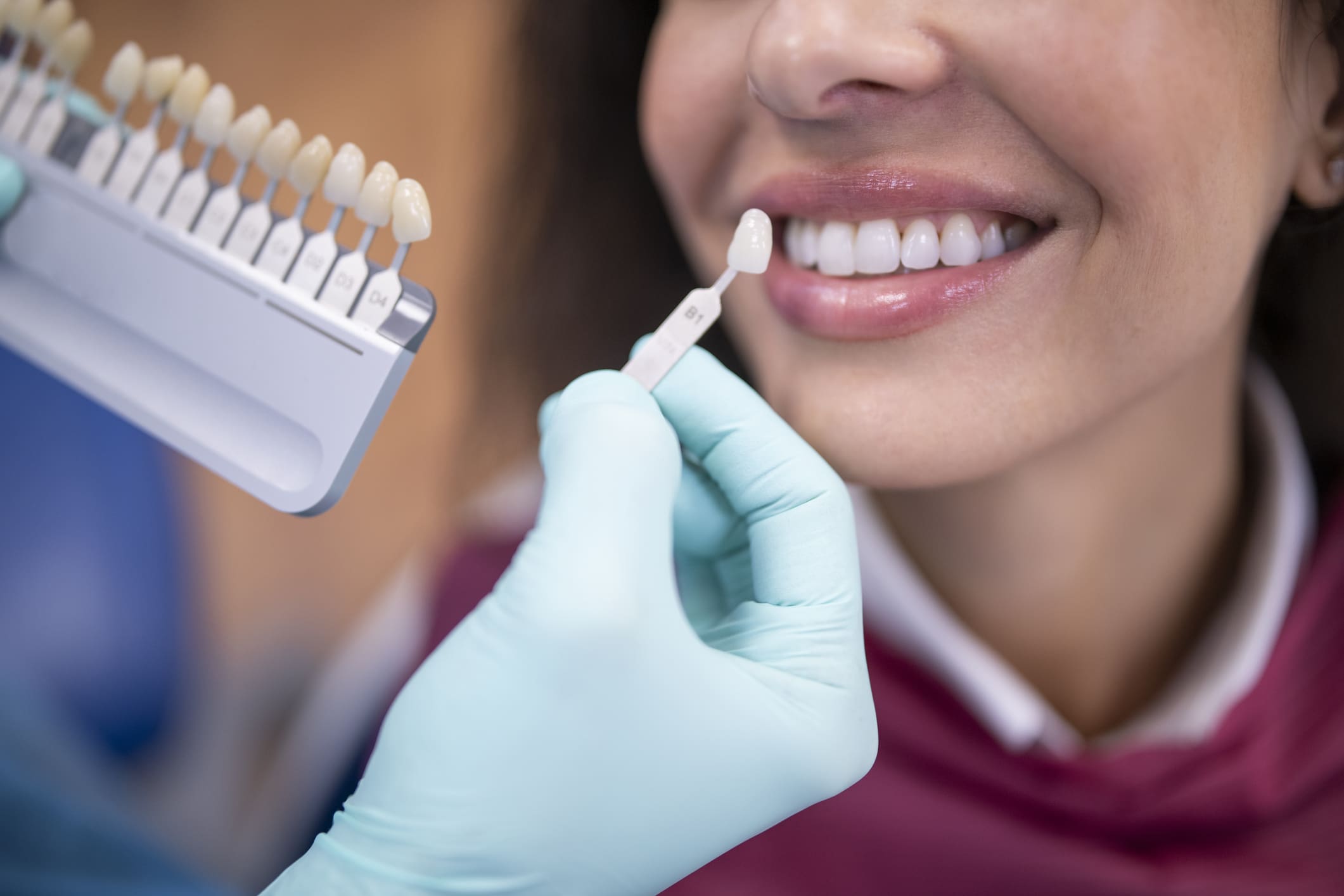
When you replace one tooth, you’re trying to match a single piece of porcelain to the natural teeth around it. That’s a much harder problem, and it’s where many single-veneer cases go wrong.
Here’s why. Natural teeth aren’t uniform. They vary subtly in color, translucency, and surface texture. The tooth next to the one you want to fix might be slightly warmer in tone, or have a small white spot, or reflect light differently. If the new veneer matches a shade guide but not the specific characteristics of the neighboring teeth, it will stand out.
That’s the opposite of what you want. You’re getting a porcelain veneer in Skokie because you want the tooth to blend in. If it doesn’t blend, you’ve spent money to create a new problem.
When a Single Veneer Works Well
A single veneer can be a great solution in certain situations, including:
- The tooth is chipped or broken. If the damage is confined to the front surface and the surrounding teeth are healthy, a single veneer can restore the tooth’s shape and appearance without affecting its neighbors.
- The tooth is discolored, and whitening hasn’t worked. Some stains, especially those from old trauma or certain medications, don’t respond to whitening. A veneer can cover the discoloration while matching the surrounding teeth.
- The tooth is slightly rotated or misshapen. A veneer can change the tooth’s apparent shape without orthodontics, as long as the bite is healthy.
- The adjacent teeth are similar in shade and texture. If the teeth on either side of the problem tooth are relatively uniform, matching a single veneer is more achievable.
- You’re willing to accept some compromise. Even in the best case, a single veneer won’t be a perfect match. It’ll be very close, but a trained eye might notice a subtle difference. If that works for you, a single veneer can work well.
When a Single Veneer Creates a Bigger Problem
Here’s where it gets tricky. A single veneer can create a bigger issue when:
- The adjacent teeth are varied. If the teeth around the problem tooth have different shades, textures, or small imperfections, matching one veneer to all of them is nearly impossible. You’ll end up with a veneer that looks slightly off no matter what you do.
- The problem tooth is significantly different in color. If the tooth you want to fix is much darker or lighter than its neighbors, a single veneer can’t bridge that gap without looking artificial. In these cases, whitening the surrounding teeth first, or using a small set of veneers, often produces a better result.
- The bite is uneven. If the tooth is taking more force than it should, a veneer on that tooth may chip or fail. Address the bite first.
- The gums are uneven. If the gumline around the problem tooth is different from the surrounding teeth, a veneer alone won’t fix the asymmetry. Gum contouring may be needed.
- You’re a perfectionist. Some patients are never happy with a single veneer because they can always see the difference. If you’re that person, a small set of four or six veneers often produces a result you’re happier with, because the whole smile is coordinated.
Why the Number Matters More Than You Think
Here’s what patients don’t always understand. The number of veneers isn’t just about how many teeth are “bad.” It’s about how many teeth you need to include to create a cohesive, natural-looking result.
A skilled cosmetic dentist looks at the smile as a whole. If you’re fixing one tooth but the two teeth next to it have subtle flaws that will become more noticeable once the new veneer is in place, the result may look off. Adding those teeth to the treatment plan can create a more balanced outcome.
Dr. Chaiken evaluates the shade, shape, and translucency of the surrounding teeth before recommending a plan. He’s not trying to sell you more veneers. He’s trying to get you the result you actually want.
What Dr. Chaiken and Dr. Frazier Bring to the Conversation
Both dentists have the training and experience to have this conversation honestly.
Dr. Chaiken has practiced for more than 40 years and completed advanced training in cosmetic dentistry. He holds fellowships from the American College of Dentists and the Academy of General Dentistry, and he’s an assistant clinical professor at Northwestern University School of Medicine. He’s seen thousands of smiles and knows what looks natural and what doesn’t.
Dr. Frazier has a special interest in cosmetic dentistry and oral surgery, and she’s completed extensive advanced training in implant dentistry. She’s a member of the American Dental Association, the Illinois State Dental Society, the Chicago Dental Society, and the Academy of General Dentistry. She approaches each case with a focus on both function and beauty.
Together, they evaluate the tooth, the smile, and the face. They’re not just looking at the tooth that’s bothering you. They’re looking at the whole picture.
What to Ask Before You Commit
If you’re considering a single veneer, here are a few questions you should ask:
- Can you show me a preview? A good cosmetic dentist can show you a digital preview or mockup of the result before making the veneer.
- How close can you match the surrounding teeth? The answer should be honest. A perfect match isn’t always possible, but a very close one often is.
- Will I be happier with one veneer or a small set? Ask the dentist for their honest opinion. If they recommend a small set, ask why.
- What happens if I’m not happy with the result? Ask about the process for adjustments or remakes.
- Are there alternatives to a veneer? Bonding, crowns, and orthodontics are all options in certain cases. Ask about all of them.
At North Dental Professionals, we’ll answer all of these questions before you commit to anything.
Where to Find Us
Our Skokie office is at 4905 Old Orchard Shopping Ctr, Suite 535, Skokie, IL 60077, near the Evanston border. We serve patients from Skokie, Evanston, Niles, Morton Grove, Lincolnwood, and the surrounding north suburbs. Our Chicago office is in the Edison Park area on the northwest side.
Call us at 224-298-7907, or request an appointment online.
You don’t have to settle for a result that looks off. Visit our Skokie dental practice today.